Every shaft that pushes forward — whether it's a ship's propeller, a turbine rotor, or an automotive crankshaft — needs something to absorb that axial force. That something is a thrust bearing. In 2026, the global thrust bearing market reached $3.98 billion, growing at 7% CAGR, driven by EV powertrains, offshore wind installations, and industrial automation (Research and Markets).
That thrust-bearing segment sits inside a broader rolling-bearing market worth roughly USD 130–175 billion (2025), dominated by a handful of top bearing manufacturers. But "thrust bearing" isn't a single product — it's a family of six distinct designs, each suited to wildly different speed, load, and precision requirements. Choosing wrong doesn't just underperform; it fails catastrophically. This guide covers all six types with real engineering data so you can match the right thrust bearing to your application.
Key Takeaways
- A thrust bearing handles axial loads (parallel to the shaft) at contact angles of 45–90°. Six major types exist: ball, cylindrical roller, needle roller, tapered roller, spherical roller, and tilting-pad fluid-film.
- Thrust ball bearings hold 38.5% of the $2.34 B market by type share, but roller and fluid-film types dominate heavy industry (Dataintelo).
- Tilting-pad thrust bearings handle sliding speeds up to 160 m/s — 3–5× beyond any rolling-element design (Miba).
- Selection depends on four parameters: axial load magnitude, operating speed, misalignment tolerance, and envelope space.
What Is a Thrust Bearing?
In 2026, NTN's engineering catalog defines thrust bearings as bearings "designed primarily to support axial loads at contact angles between 45° and 90°" (NTN Corporation). That contact angle is the dividing line: anything below 45° is classified as a radial bearing. Anything at or above it — that's a thrust bearing, built to resist forces pushing along the shaft's axis rather than perpendicular to it.
The working principle splits into two families. Rolling-element thrust bearings use balls or rollers between hardened raceways (called "washers" in thrust configurations). Fluid-film thrust bearings generate a hydrodynamic oil wedge between tilting pads and a rotating collar — no rolling contact at all.
Why does this distinction matter? Because the two families serve completely different application regimes. Rolling-element types handle moderate speeds and are compact, greased, and field-replaceable. Fluid-film types serve extreme speeds and loads in turbomachinery — they're permanently installed, oil-circulated, and instrumented with temperature sensors.
From our catalog: ANDE supplies thrust ball bearings (51100–51400 series) and spherical roller thrust bearings (29200–29400 series) across bore diameters from 10 mm to 1,250 mm. The most common failure we see in the field isn't overload — it's inadequate preload causing roller skidding, especially in vertical-shaft pump applications.
Every thrust bearing — rolling or fluid-film — needs a continuous axial load to function. Without it, rolling elements skid against raceways rather than rolling, causing premature wear. That's why NTN's catalog explicitly states: "it is necessary to supply an axial load in order to prevent slipping between the bearing's rolling elements and raceways."
If you're unsure whether your application generates axial loads at all, start with our bearing vs bushing comparison — sometimes the answer isn't a thrust bearing but a different solution entirely.
What Are the 6 Types of Thrust Bearings?
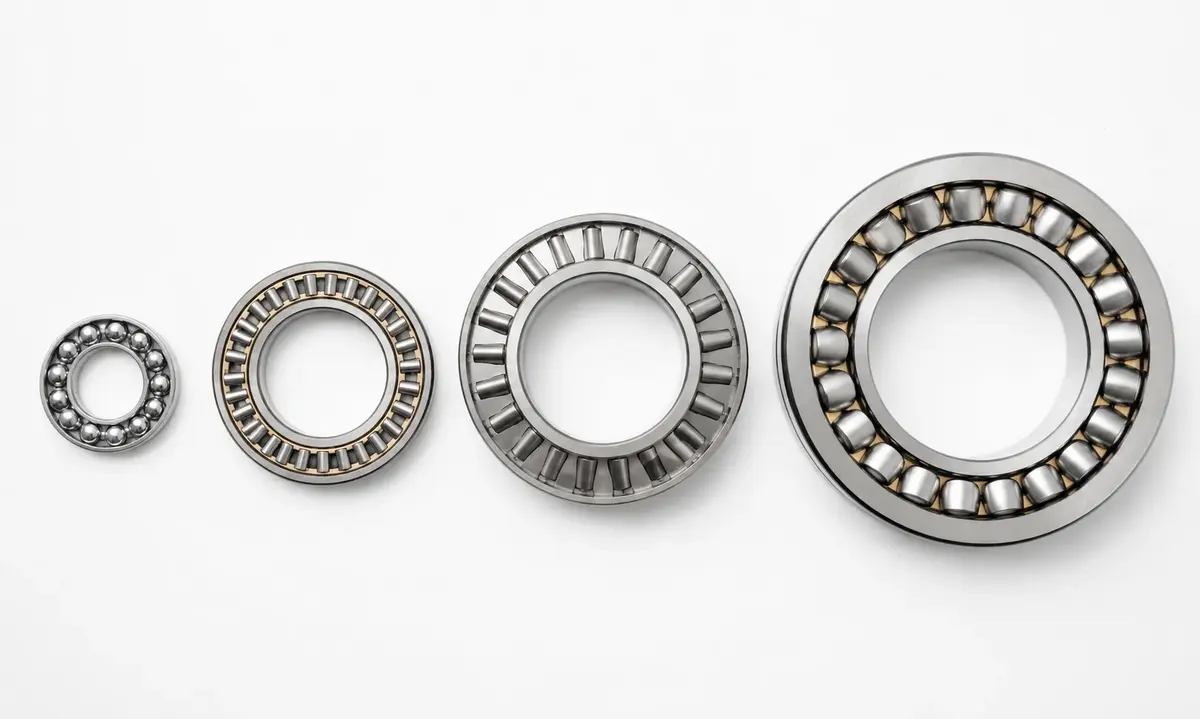
Rolling-element thrust bearings come in five configurations — ball, cylindrical roller, needle roller, tapered roller, and spherical roller — plus a sixth category: fluid-film tilting-pad designs used in turbomachinery. Each trades off load capacity, speed, self-alignment, and physical size differently.
Here's how they compare at a glance:
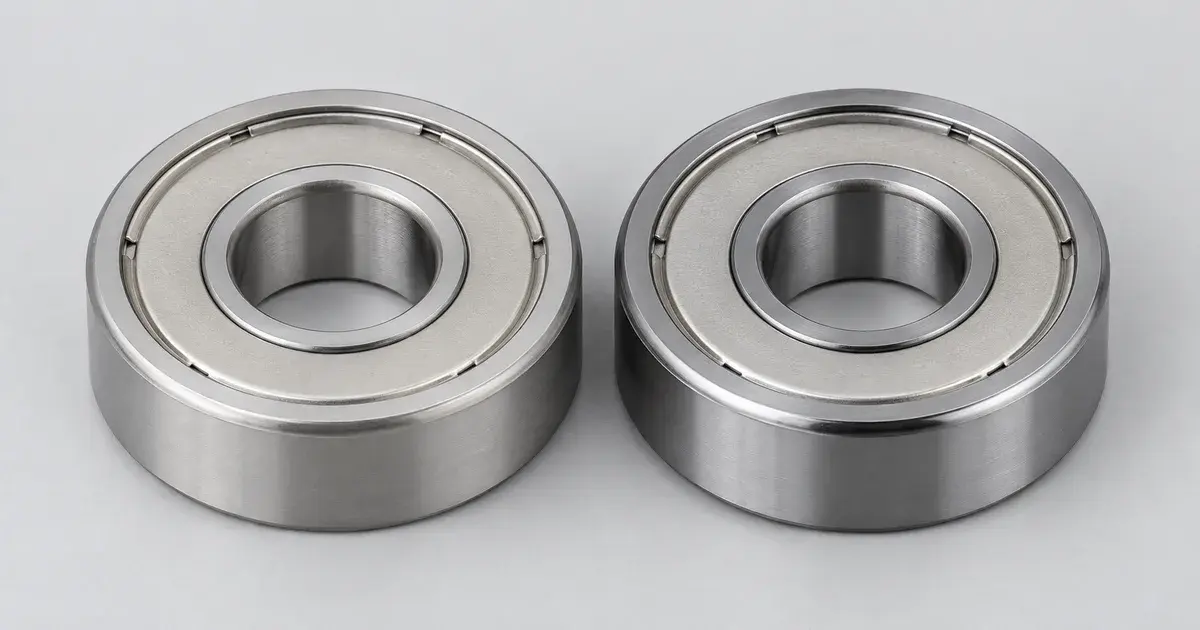
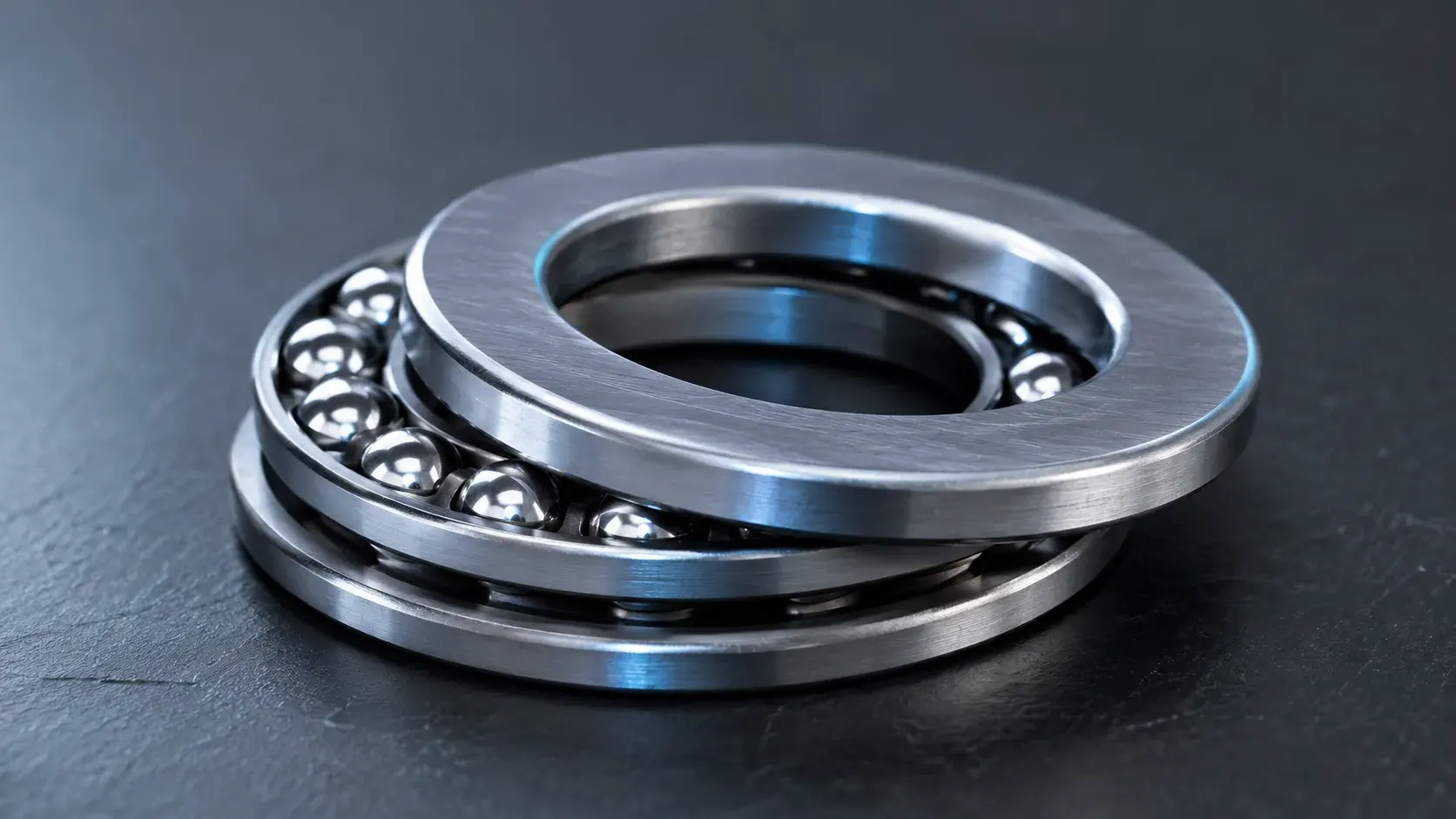
Thrust ball bearings (51100–51400 series) are the lightest-duty option. Steel balls sit between two washer-shaped raceways at a 90° contact angle. They're cheap, compact, and fast — but they can't handle heavy axial loads or any radial load whatsoever.
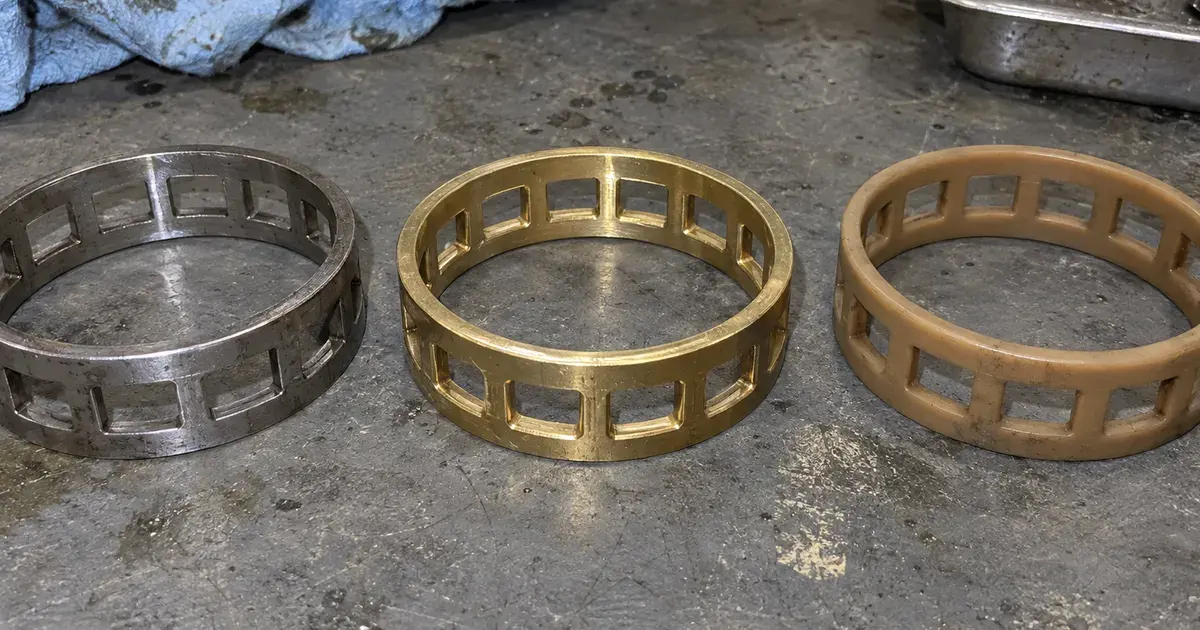
Cylindrical roller thrust bearings (811/812/893 series) replace balls with short cylindrical rollers for dramatically higher load capacity and axial rigidity. The trade-off? Higher friction and lower speed limits. NTN manufactures these with machined brass cages for demanding industrial applications.
Needle roller thrust bearings split the difference between space and capacity. Their slender rollers (length >> diameter) pack high load capacity into a thin axial profile, making them the default choice when installation space is severely limited — think automotive transmissions and drive shafts. See our guide to needle roller bearings for the full family, including the radial and combined types.
Tapered roller thrust bearings (Timken's TTHD/TTHDFL series) use controlled-contour tapered rollers converging at a common apex for true rolling motion. This geometry delivers the highest capacity of any rolling-element thrust bearing of equivalent size, and — unlike other types — it can accommodate some radial load. Maximum O.D. speeds reach 25–30 m/s (Timken).
Spherical roller thrust bearings (29200–29400 series) are the heavy-load champions. Their barrel-shaped rollers and spherical raceways self-align under misalignment of 1/60 to 1/30 (approximately 1°–2°), compensating for shaft deflection under extreme loads (NTN). They can handle combined loads where radial doesn't exceed 55% of axial (Fr/Fa ≤ 0.55). Oil lubrication is mandatory — even at low speeds.
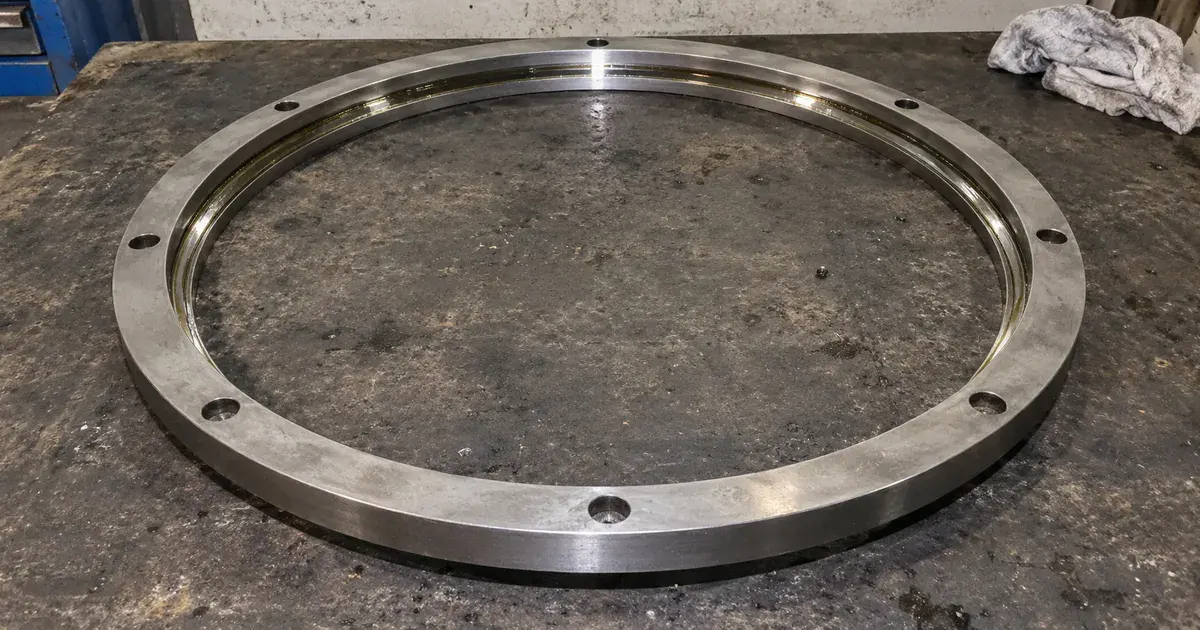
Tilting-pad thrust bearings (fluid-film) are an entirely different species. Instead of rolling elements, individual pads tilt to form a hydrodynamic oil wedge against a rotating collar. They're rated to sliding speeds of 160 m/s and beyond (Miba), handling loads that would instantly destroy any rolling-element bearing. We'll cover these in depth below.
For context on how these six types fit within the broader bearing universe, see our complete guide to different kinds of bearings.
How Do Thrust Ball Bearings Compare to Thrust Roller Bearings?
In 2025, ball thrust bearings commanded 38.5% of the global thrust bearing market by revenue, while roller thrust types held 28.3% (Dataintelo). That split reflects a fundamental engineering trade-off: balls run faster with less friction but carry lighter loads; rollers offer superior load capacity at the cost of speed and simplicity.
Here's the practical decision framework:
Choose thrust ball bearings when:
- Axial loads are light to moderate
- Operating speeds are high (they're the fastest rolling-element thrust type)
- You need a compact, low-cost, easy-to-install solution
- The application is a clutch, fan, pump, or household appliance
Choose thrust roller bearings when:
- Axial loads are heavy (cylindrical rollers provide 2–5× the capacity of equivalently-sized ball thrust bearings)
- You need high axial rigidity (machine tool rotary tables, screw presses)
- Space is limited axially but loads are significant (needle roller types)
- Combined axial + radial loads exist (tapered roller types only)
The reason for this split is contact geometry. A ball contacts a flat raceway at a point — under load, that point becomes a tiny ellipse. A roller contacts along a line, distributing load over a much larger area. More contact area means more capacity, but also more friction from differential sliding across the roller face.
According to Dataintelo's 2025 market research, the ball thrust segment is growing at 5.0% CAGR through 2034, while roller thrust grows faster at 5.4% — reflecting increasing industrial automation and the need for heavier-duty axial load solutions in manufacturing equipment (Dataintelo). Magnetic thrust bearings, though only 15% of the market today, are the fastest-growing segment at 6.2% CAGR, driven by semiconductor and aerospace applications requiring zero-contact, zero-lubricant operation.
So which one should you actually buy? If your application sees axial loads under 10 kN and speeds above 3,000 rpm, start with a thrust ball bearing — it's simpler and cheaper. If loads exceed that or you need rigidity for positioning accuracy, move to cylindrical or tapered rollers. For combined loading with misalignment, jump straight to spherical roller thrust. And for anything above 30 m/s surface speed, you're in tilting-pad territory.
For more on how dynamic and static load ratings govern bearing selection, see our dynamic vs static load guide.
Why Do Turbines Use Tilting-Pad Thrust Bearings?
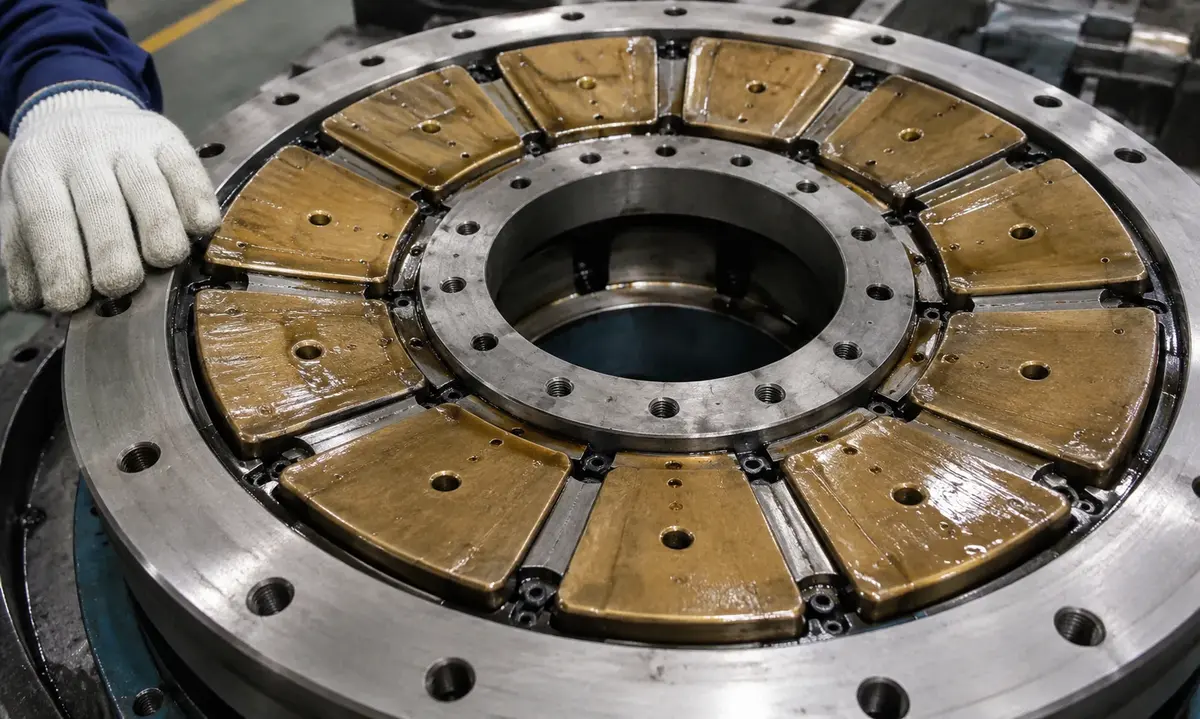
In 2015, researchers at MDPI documented that large tilting-pad thrust bearings in hydrogenerators can reach 5 metres in diameter and generate up to 1 MW of friction heat — roughly enough to power 300 homes (MDPI Lubricants). No rolling-element bearing could survive these conditions. That's why every major turbine, compressor, and generator uses tilting-pad (also called Kingsbury-type) thrust bearings for axial load support.
The principle is elegant: individual pads pivot on their supports, tilting just enough to create a converging oil wedge between the pad surface and the rotating thrust collar. This wedge generates hydrodynamic pressure that separates metal from metal entirely — the minimum oil film is just 20–50 μm thick, thinner than a human hair, at relative speeds of 40–45 m/s (~150 km/h).
Miba's catalog rates their tilting-pad thrust bearings for sliding speeds up to 160 m/s and specific loads of 2.5 MPa, using VG32 oil with directed lubrication and offset pivots (Miba). Compare that to the fastest rolling-element type — Timken's TTHD tapered rollers top out at 25–30 m/s. The fluid-film design offers 5× the speed capability.
What most guides miss: Nearly every "thrust bearing" article online covers only rolling-element types. But in turbomachinery — steam turbines, gas turbines, hydrogenerators, large compressors — the tilting-pad is the only viable option. A single tilting-pad thrust bearing in a 500 MW steam turbine might cost $30,000–$80,000 and carry 2+ MN of axial thrust. Ignoring this category means ignoring the highest-value segment of the thrust bearing market.
The engineering design parameters for tilting-pad thrust bearings differ completely from rolling-element selection. Instead of ISO 281 life calculations, designers work with minimum film thickness (target >20 μm), maximum pad temperature (babbitt limit ~121°C / 250°F), and specific bearing load (typically 2–4 MPa). The Nicholas/Dyrobes design paper recommends placing temperature sensors at the 75% pad arc position from the leading edge, and sets alarm at 110°C (230°F), trip at 121°C (250°F) (Nicholas, Texas A&M Turbomachinery Symposium).
One remarkable finding from the MDPI research: in some large bearings operating at 40+ m/s, over 30% of total power loss occurs outside the oil film — from churning and mixing of oil within the bearing housing. This has driven development of directed-lubrication designs (like Miba's) that feed oil precisely onto pad leading edges rather than flooding the entire housing.
Where Are Thrust Bearings Used?
In 2025, the Asia Pacific region commanded 42.8% of global thrust bearing revenue — approximately $1.0 billion — driven primarily by China's position as the world's largest automotive manufacturing hub with ~39% of its output now being electric vehicles (Dataintelo). But thrust bearings serve far more than cars.
Automotive and EV
Every internal combustion engine uses at least one thrust bearing on the crankshaft to control axial end-play — typically a pair of flanged half-shells or dedicated thrust washers. The transmission adds more: thrust needle bearings on planetary gear sets, thrust ball bearings on the clutch release mechanism. EVs are actually increasing demand: high-speed traction motors (20,000+ rpm) require precision thrust bearings to handle electromagnetic axial forces that don't exist in combustion engines.
Heavy Industry and Rolling Mills
Steel mills use TTHD and TTHDFL tapered roller thrust bearings in screw-down systems that apply rolling force to work rolls. Timken developed these designs specifically for "breaker block" applications where enormous thrust loads combine with heavy shock. Crane hooks, extruders, cone crushers, and pulp refiners all rely on these heavy-duty thrust bearings. For more on mill bearing selection, see our rolling mill bearings guide.
Turbomachinery and Power Generation
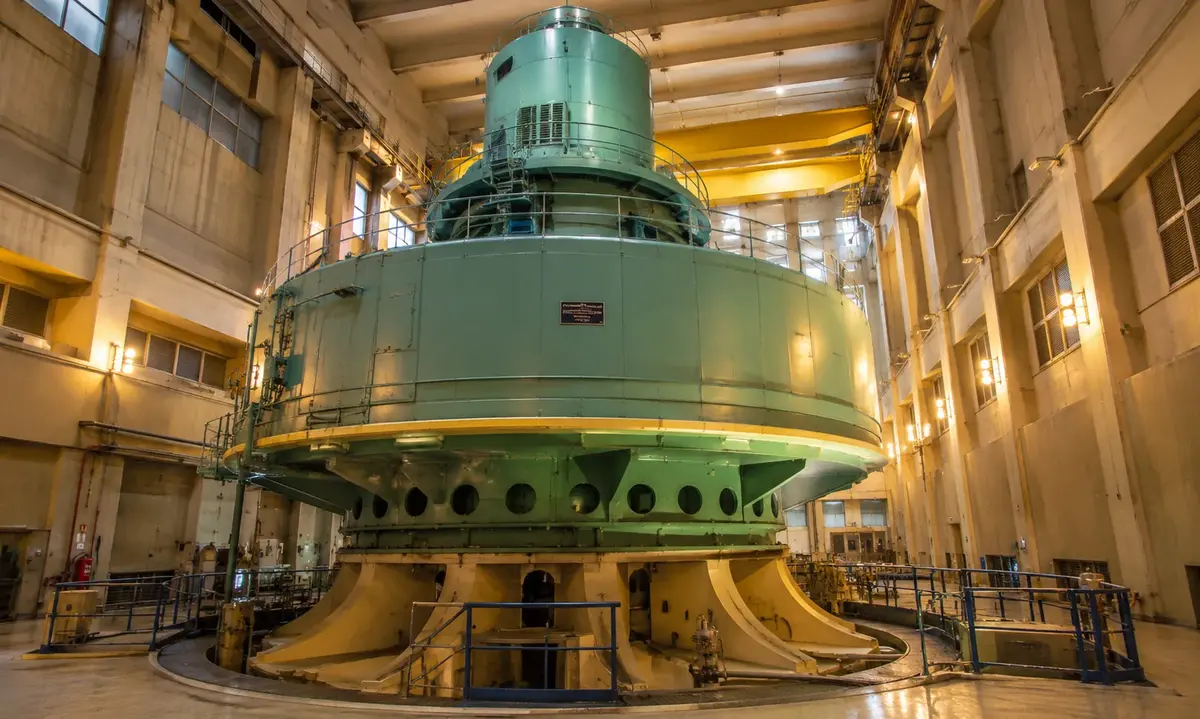
Steam turbines, gas turbines, hydrogenerators, and large centrifugal compressors — essentially any machine with a high-speed rotor generating axial thrust — use tilting-pad fluid-film thrust bearings. A single unit in a large hydrogenerator can support 2.25 MN (230 tonnes) of axial thrust at 600 rpm.
Marine and Oil & Gas
Ship propeller shafts transmit enormous forward thrust from the propeller to the hull through a dedicated thrust bearing block (historically called a "Michell bearing" or "Kingsbury bearing" depending on geography). Oil and gas operators use corrosion-resistant thrust bearings in subsea wellhead equipment at extreme pressures and temperatures.
From our field work: ANDE recently supplied 29340M spherical roller thrust bearings for a cement plant's vertical raw mill. The previous cylindrical roller thrust bearing failed every 8 months from misalignment caused by foundation settling. The spherical type's 1.5° self-alignment tolerance eliminated the failure mode entirely — no alignment modifications to the mill frame were needed. The bearings are still running after 14 months.
How Do You Select the Right Thrust Bearing?
According to NTN's engineering guidance, thrust bearing selection depends on four parameters: axial load magnitude, operating speed (expressed as a DN value or surface velocity), misalignment tolerance, and available envelope space (NTN). The upper unit load design limit for tilting-pad journal and thrust bearings is 200 psi (1.38 MPa), with surface velocity limits of 300 ft/s (91 m/s) for standard designs (Nicholas, Texas A&M).
Here's a simplified selection logic you can use:
Step 1: Determine your axial load.
- Light (< 10 kN): Start with thrust ball bearings
- Medium (10–100 kN): Consider cylindrical or needle roller thrust
- Heavy (100+ kN): Tapered roller or spherical roller thrust
- Extreme (> 500 kN with high speed): Tilting-pad fluid-film
Step 2: Check your speed.
- If surface velocity exceeds 25–30 m/s (the rolling-element ceiling), you must use tilting-pad.
- For rolling-element types: ball bearings tolerate the highest speeds; cylindrical rollers the lowest.
Step 3: Assess misalignment.
- If shaft deflection or housing misalignment is expected: spherical roller thrust (1°–2° self-alignment) or tilting-pad (pad tilt compensates).
- If alignment is tight and predictable: any type works.
Step 4: Measure available space.
- Tight axial envelope: needle roller thrust (thinnest profile)
- Generous space: any type; optimize for load/speed
Step 5: Consider combined loading.
- Pure axial only: ball, cylindrical, needle
- Combined axial + radial (Fr/Fa ≤ 0.55): tapered roller or spherical roller thrust
- Combined at high speed: paired angular contact ball bearings might be a better architecture than a pure thrust bearing
Where the load case is a genuine mix rather than thrust with a little radial on top, the question stops being which thrust bearing and starts being how much thrust a radial bearing will take. That threshold, and the arithmetic that converts combined axial and radial load into the single figure a catalogue rates, is covered separately.
One more factor that most selection guides miss: lubrication compatibility. Rolling-element thrust bearings work with grease or oil. Spherical roller thrust bearings require oil lubrication even at low speeds (per NTN). And tilting-pad bearings require forced oil circulation with external cooling — a totally different lubrication infrastructure.
For background on the ISO life calculation that governs rolling-element thrust bearing sizing, see our dynamic vs static load ratings guide.
What Causes Thrust Bearing Failure?
The Nicholas/Dyrobes paper for the 23rd Texas A&M Turbomachinery Symposium reports that babbitt — the soft white-metal alloy lining fluid-film thrust bearing pads — softens at approximately 121–135°C (250–275°F) and begins to wipe or smear under load at these temperatures (Nicholas). For rolling-element types, failure follows different physics — but it's equally predictable.
Rolling-Element Thrust Bearing Failures
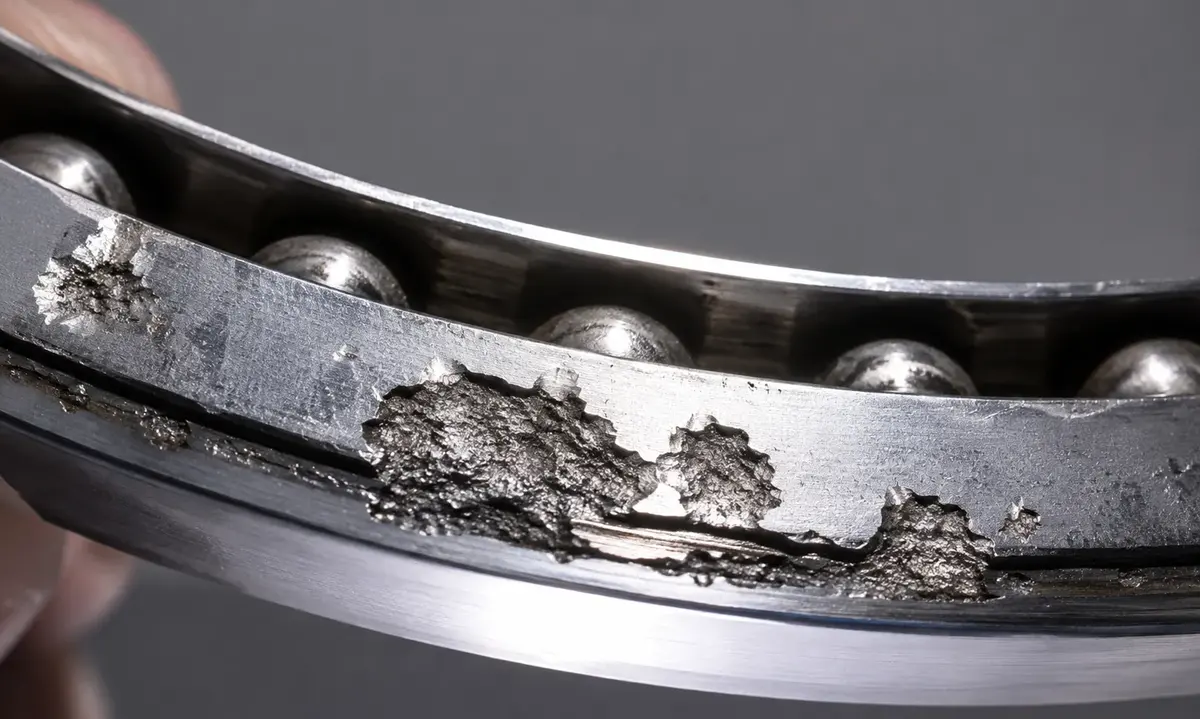
Fatigue spalling is the designed failure mode. Per ISO 281, every rolling bearing has a calculated L₁₀ life — the number of revolutions at which 10% of a population will show fatigue-induced flaking on raceways. This isn't a defect; it's metallurgical certainty. Exceeding rated load or operating in contaminated environments accelerates spalling dramatically.
Inadequate preload causes roller or ball skidding — the elements slide rather than roll, generating localized heat and surface damage. This is especially common in vertical-shaft applications where gravity doesn't provide natural preload. Every thrust bearing needs continuous axial load to function properly.
Lubrication starvation — either wrong viscosity, insufficient quantity, or contamination — accounts for a large share of premature failures. For spherical roller thrust bearings, oil lubrication is mandatory; grease will not reach the roller-raceway contacts adequately.
Fluid-Film Thrust Bearing Failures
Thermal runaway occurs when film thickness drops below the safe minimum (~20 μm), increasing friction, which increases temperature, which reduces oil viscosity, which further reduces film thickness — a positive feedback loop that ends in babbitt wipe. That's why temperature monitoring is non-negotiable: recommended alarm at 110°C (230°F), trip at 121°C (250°F).
Oil supply failure — if the lubricant pump trips, the bearing has seconds before contact. Many critical turbomachines include emergency DC oil pumps and oil accumulators for exactly this scenario.
Misalignment in non-self-aligning pad designs causes one side of the pad to run thinner than the other, concentrating load on an edge. The Nicholas paper recommends dual side-by-side temperature sensors on non-aligning pads to detect asymmetric temperature patterns before damage occurs.
Preventing thrust bearing failure starts at design time: select the correct type, verify the life calculation or film thickness analysis, specify the right lubrication system, and install temperature monitoring for critical applications. For more on bearing failure mechanisms in rolling mills specifically, see our hot strip mill bearing failure analysis.
Thrust Bearing Market in 2026: What's Driving Growth?
In 2026, the global thrust bearing market reached $3.98 billion, up from $3.72 billion in 2025, representing a 7% year-over-year growth rate. The market is projected to reach $5.25 billion by 2030 at a sustained 7.2% CAGR (Research and Markets).
Three forces are driving this acceleration:
Electric vehicle production is the dominant near-term driver. EV traction motors operate at 15,000–20,000+ rpm — significantly faster than ICE transmissions — requiring higher-precision thrust bearings for axial load management. German automotive R&D spending hit €58.4 billion in 2023, up 11% year-over-year, with a growing share directed at EV powertrain components including bearing assemblies.
Offshore wind installations are expanding procurement of heavy-load roller thrust bearings for next-generation turbine gearboxes. A single offshore wind turbine can require spherical roller thrust bearings carrying 500+ kN of axial thrust from blade pitch forces.
Industrial automation — particularly in precision machine tools, semiconductor manufacturing, and automated warehousing — demands thrust bearings with tighter tolerances and longer maintenance intervals.
The competitive landscape is dominated by SKF, Timken, NSK, NTN, JTEKT (Koyo), and Schaeffler. Notable 2024 M&A activity: Zhejiang XCC Group (China) acquired WJB Automotive LLC (USA) in April 2024 to combine Chinese manufacturing scale with American market access and automotive expertise.
Frequently Asked Questions
Q: What is the difference between a thrust bearing and a radial bearing?
A thrust bearing supports axial loads — forces parallel to the shaft axis — at contact angles between 45° and 90° (NTN). A radial bearing supports loads perpendicular to the shaft. Most rotating machines need both: radial bearings carry the shaft's weight, and thrust bearings control its axial position. Some bearing types (tapered roller, angular contact) handle both simultaneously.
Q: What is a journal bearing vs a thrust bearing?
A journal bearing is a radial plain bearing — the shaft "journal" rotates inside a cylindrical sleeve. A thrust bearing handles axial forces. In turbomachinery, both are often tilting-pad hydrodynamic designs, but they support different load directions. For a broader comparison of plain vs rolling-element solutions, see our bearing vs bushing guide.
Q: Can a thrust bearing handle radial loads?
Only specific types. Tapered roller thrust bearings and spherical roller thrust bearings can accommodate combined axial + radial loading, but the radial component must not exceed 55% of the axial load (Fr/Fa ≤ 0.55) per NTN specifications. Thrust ball bearings and cylindrical roller thrust types handle axial loads exclusively — applying radial force to them causes immediate damage.
Q: How long does a thrust bearing last?
Rolling-element thrust bearings follow the L₁₀ fatigue life equation per ISO 281 — life is inversely proportional to the cube of the applied load (for ball types) or the 10/3 power (for roller types). Tilting-pad fluid-film bearings theoretically last indefinitely if film thickness stays above 20 μm and babbitt temperature remains below the 85°C (185°F) design prediction limit — they have no fatigue mechanism.
Q: What causes thrust bearing noise?
Insufficient axial preload is the most common cause — without continuous load, rolling elements rattle between raceways. Other causes include contamination (grit in the lubricant), cage damage from improper handling, and roller skidding from inadequate minimum load. A low-frequency "rumble" often indicates incipient spalling detectable via vibration analysis before visible damage appears.
Choosing the Right Thrust Bearing: Summary
Thrust bearings aren't one-size-fits-all. The $3.98 billion market exists precisely because different applications need fundamentally different designs:
- Light axial loads at high speed → thrust ball bearing (51xxx series)
- Heavy axial loads, high rigidity → cylindrical roller thrust (811/812 series)
- Compact space, moderate loads → needle roller thrust (AXK/NTA)
- Maximum capacity + combined loads → tapered roller thrust (TTHD/TTHDFL)
- Heavy loads + misalignment → spherical roller thrust (292/293/294 series)
- Extreme speed (>30 m/s) → tilting-pad fluid-film (Kingsbury/Miba type)
The selection fundamentals haven't changed: match your load, speed, alignment, and space constraints to the type that fits. What has changed is the market context — EV powertrains, offshore wind, and industrial automation are pushing demand for both ends of the spectrum simultaneously.
Need help specifying a thrust bearing for your application? Contact ANDE Bearing's engineering team for technical selection support, custom configurations, and supply from our 10 mm–1,250 mm bore range.